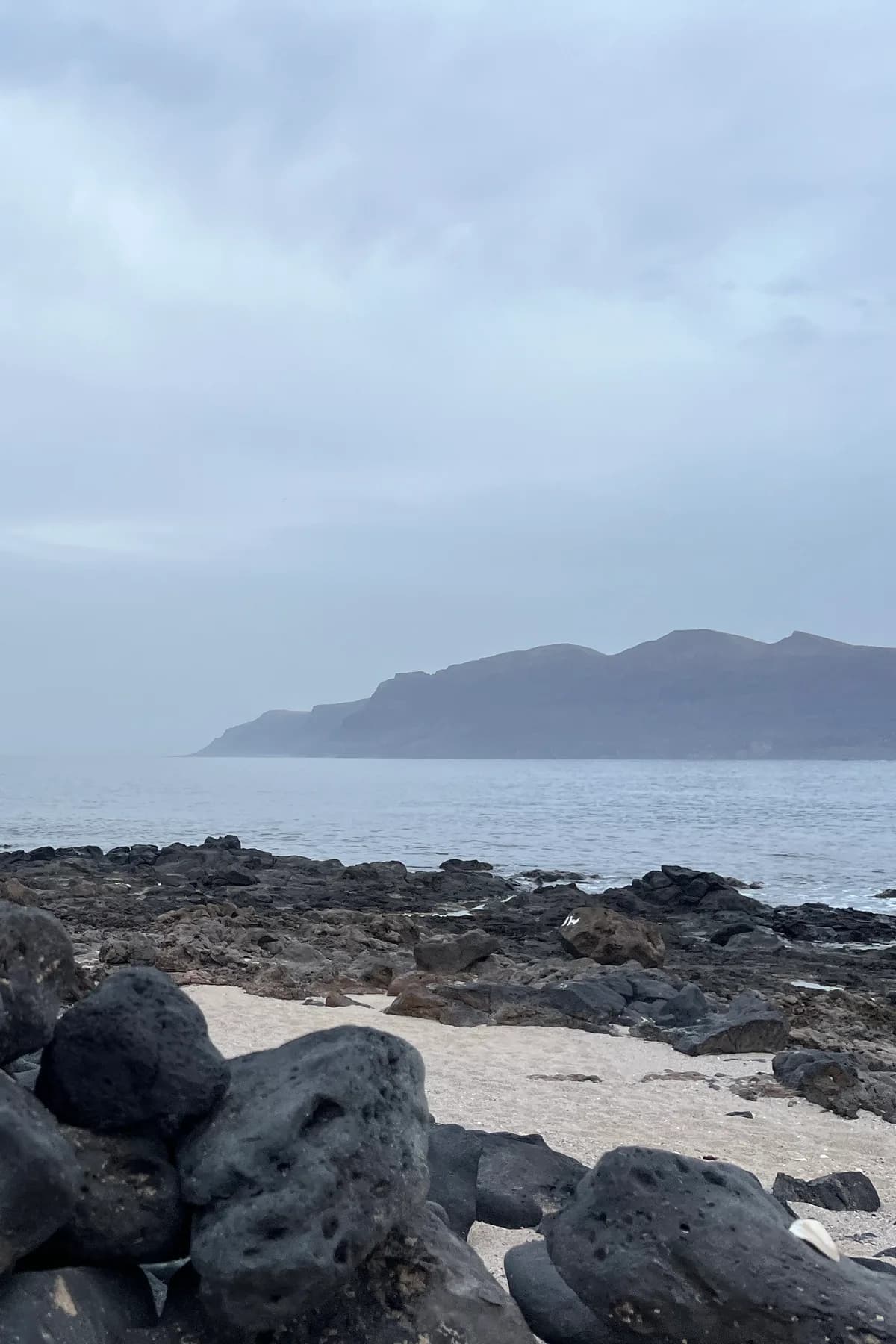
The Canaries have eight inhabited islands — and a ninth that refuses to be caught. For centuries, sailors and villagers have sworn they've seen on the horizon a mountainous island where the maps show nothing: San Borondón (St Brendan's isle), named after the Irish monk St Brendan, who according to the medieval legend disembarked on the back of an island that turned out to be... something else. The phantom island even appeared on official maps, expeditions were organised to find it and there were notarised affidavits of sightings. Science speaks of mirages, clouds and banks of sea mist. The Canarians, with a smile, still watch the horizon on the strange days. From the heights of Famara, who knows: sunsets with calima (Saharan dust haze) are suspiciously generous with silhouettes.
Every seafaring culture has its phantom island; the Canaries' one has a navigator saint's name and an official file. The legend begins in sixth-century Ireland with St Brendan of Clonfert — Saint Brendan, San Borondón in Canarian speech —, the monk who according to the medieval accounts put to sea with his brothers in a leather boat in search of Paradise. The "Navigatio Sancti Brendani", an absolute bestseller of the Middle Ages, tells the immortal scene: the monks land on a bare island, celebrate Mass, light a fire… and the island shudders and submerges — it was the back of a colossal sea creature. From there was born the myth of the wandering island that appears and disappears.
When Europe reached the Canaries, the myth dropped anchor here. For centuries, residents of the western islands — and passing sailors — swore they saw to the west a large island, with mountains and valleys, that appeared on no chart. The sightings were so persistent that San Borondón leapt into serious cartography: it appears drawn on maps from the sixteenth to the eighteenth centuries, with shape and position, and the Treaty of Alcáçovas and other documents of the period go as far as mentioning the Canary Islands "yet to be discovered". Formal expeditions set sail to find it — several, with serious captains and identical results: nothing —, testimonies were taken under oath before a notary, and there were even erudite debates about whether it ought to be conquered pre-emptively. Few collective hallucinations have generated so much paperwork.
What were they really seeing? Modern science has reasonable answers, and no definitive one for every case: banks of low cloud over the sea that the sunset cuts out like solid land; superior mirages — the fata morgana, which lifts and distorts images of real, distant islands —; the calima (Saharan dust haze) playing with the light. The Atlantic optical cocktail, served to observers who already knew the legend, did the rest. But the myth earned its place in Canarian identity precisely because it could never be closed for good: the last word always remains on the horizon.
And Lanzarote? Although the classic sightings cluster around the western islands, the legend is the heritage of the whole archipelago — songs, poems, a shared emotional place-name — and this island contributes its own luxury observatory: the heights of Famara and the Mirador del Río, from which, on hazy days, the Atlantic fills with possible silhouettes. Try the local game: strange sunset, horizon to the west, eyes half-closed. That thing you may be seeing — cloud, mirage, island? — is exactly what generations of Canarians saw. Welcome to the club of those who aren't sure.
The moral is seafaring and beautiful: an archipelago that has everything reserved itself, in addition, an impossible island — so that the horizon would never run out of promises.