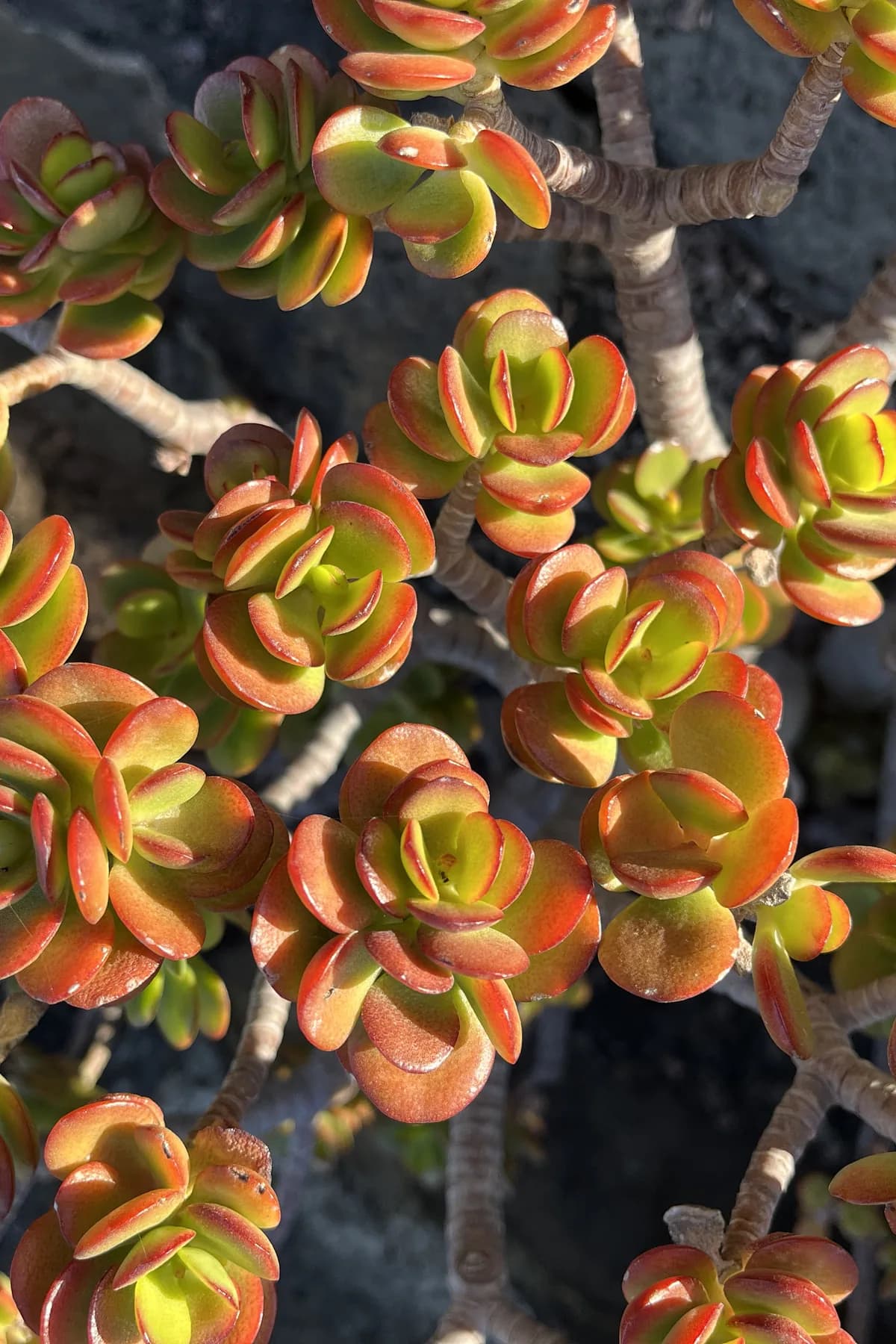
On Lanzarote's front line of coast, nothing should be able to live: salt, wind, African sun and months without a drop of rain. And yet there they are — the uvilla de mar (sea grape) with its leaves like tiny water-filled grapes, the silvery salados (saltbushes), the balancón that builds dunes, the lechuga de mar (sea lettuce) the shepherds used to eat. Each one is a survival manual: leaves turned into tanks, roots metres long, waxy skins, glands that spit out the salt. They drink from the dew, from the fog and from the moisture of the sea itself. They are the island's natural bonsai: small, tough and perfect. And they are what holds down the sand you're walking on.
If plants gave engineering classes, the ones on Lanzarote's coast would hold professorships. Their habitat is among the harshest in the plant world: soil that is barely soil, splashes of salt water, a wind that never rests and rain that can fail to appear for months. The solution was not to resist big, but small: nearly all of them are low, compact, rounded — shapes that offer the least possible surface to the wind and to evaporation.
The star is the uvilla de mar (sea grape). Its leaves are little fleshy spheres, veritable water bottles: inside it stores water — even brackish water, which very few plants in the world know how to use — and in the worst months it sacrifices whole leaves to save. It grows almost where the waves break, round and green-gold, and it is one of the most photogenic plants on the shoreline. Beside it, the salados (saltbushes) play a different card: they absorb the salt, concentrate it in special glands and expel it as tiny crystals — which is why their leaves look dusted with frost and glitter in the sun.
The balancón is the group's architect. This sturdy shrub traps the sand the wind drags along and piles it up around its base, building mounds that grow with it: that is how the dunes of El Jable and the northern beaches are born and held together. Without balancones there are no stable dunes; without dunes, the sand walks away. Every bush is a living dyke. The lechuga de mar (sea lettuce), with its fleshy, glossy rosettes in the cracks of the cliffs, was even food for shepherds and fishermen in times of scarcity.
Where do they get the water? From where nobody looks. From the dew that condenses at dawn on their cold leaves. From the maresía — that salty mist the trade winds (los alisios) push inland. From minimal rains that their shallow roots, spread out like nets, capture in minutes. Some combine two root systems: shallow ones for the dew, one deep root for the reserves.
All of which carries a practical moral: that "ugly" scrub along the beach path is infrastructure. It holds down the sand, feeds insects and lizards, shades the nests of the ringed plover. Keep to the marked paths, don't pull anything up, and look closely: in one square metre of Lanzarote coastline there is more engineering than in many buildings.