For three hundred years, seeing sails on the horizon was the worst possible news. Lanzarote — the first port of call between Europe, Africa and America — was the Canary island most punished by pirates and corsairs: Barbary raiders from Algiers, Englishmen, Frenchmen. In 1586 the corsair Morato Arráez sacked Teguise with such violence that one street has been called, ever since, the Callejón de la Sangre (Alley of Blood). In 1618, an Algerian fleet landed thousands of men; the population hid in the Cueva de los Verdes, and nearly a thousand islanders ended up sold as slaves in North Africa. From that fear remain the castles you photograph today — and a piracy museum on the heights of Teguise. This is the full story.
The geography that is Lanzarote's good fortune today was for centuries its misfortune. The island was the first Canarian landfall on the route from Europe and the Mediterranean, the closest to the Barbary coast, and the worst defended: no mountains to hide in, wells and salt pans visible from the sea, and something that fetched a high price in the slave markets of North Africa — people. Between the 16th and 18th centuries, every generation of Lanzarote islanders lived through at least one great attack. The chronicles record dozens.
Two dates hurt more than the rest. The first, 1586: the Barbary corsair Morato Arráez landed with hundreds of men, took the capital — Teguise — and subjected it to a brutal sack. Tradition places in a narrow lane beside the church the massacre of the townsfolk who failed to escape: it has been called the Callejón de la Sangre (Alley of Blood) ever since, and the name is still on the plaque, so that it is not forgotten. The second, May 1618: the greatest pirate invasion in the history of the Canaries. An Algerian fleet of dozens of ships and thousands of men landed on the island with time and method on its side. The population ran to its age-old secret refuge: the Cueva de los Verdes, the volcanic tunnel whose galleries could hide hundreds of people with their animals. This time it was not enough. The attackers blockaded the entrances and, after days of siege, around a thousand islanders — on an island of perhaps only a few thousand inhabitants — were shipped off and sold in the slave markets of Algiers. For years afterwards, families and religious orders paid ransoms to bring the captives home, one by one.
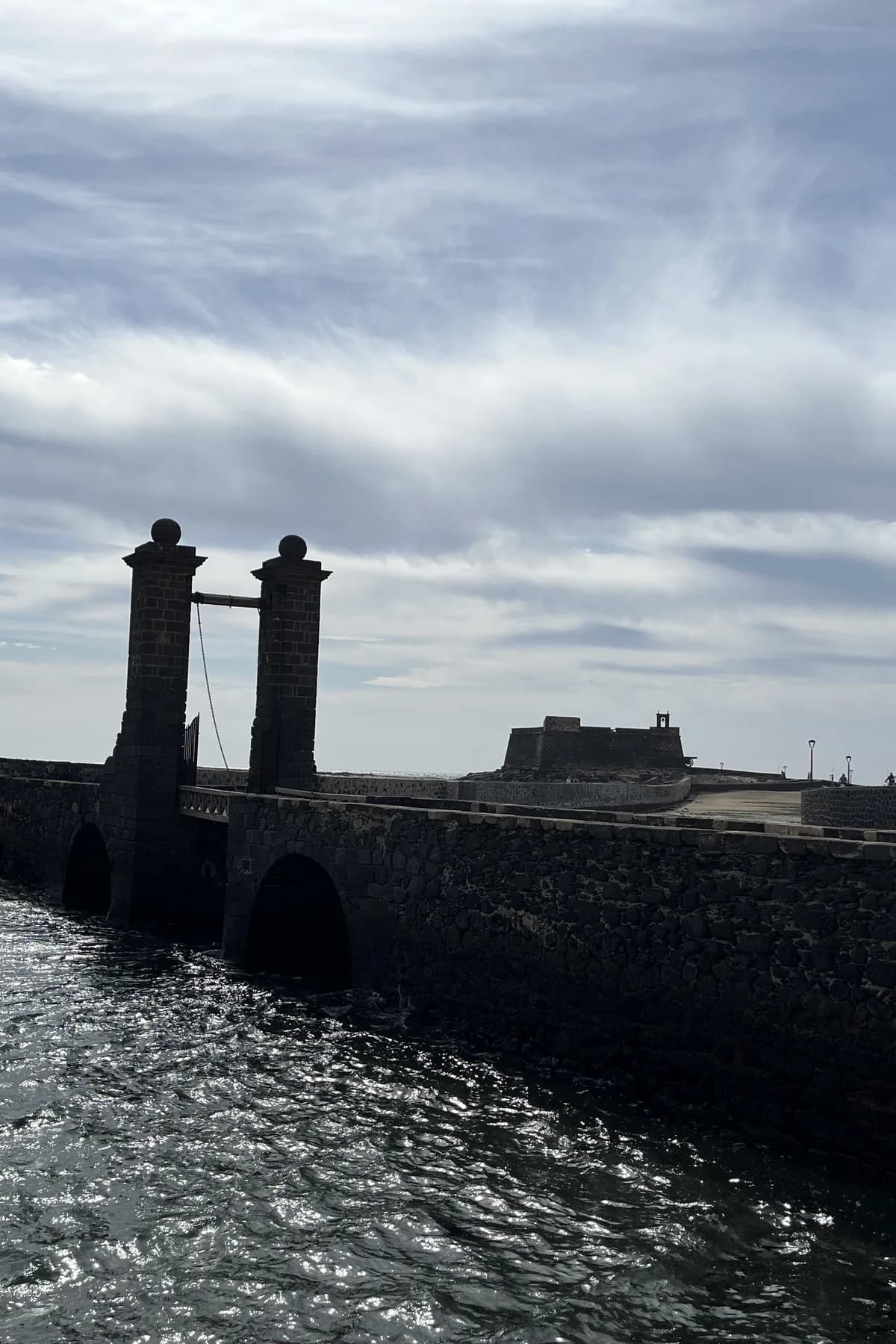
The island answered as it could: in stone. On the Guanapay volcano, watching every road into Teguise, the castle of Santa Bárbara was reinforced; in the port of Arrecife, the castle of San Gabriel protected the anchorage, and later San José completed the defences. The towers sent up smoke signals the moment suspicious sails appeared, and the townsfolk rehearsed their escape the way we rehearse a fire drill today. Even the town planning obeyed the fear: the capital sat inland precisely to gain hours of warning, and many houses hid their wealth behind austere façades.
Today that nightmare is heritage. The castle of Santa Bárbara houses — with all the logic in the world — the Museo de la Piratería (Piracy Museum); San Gabriel now watches over the strollers on the Puente de las Bolas; and the Cueva de los Verdes tells its visitors that, before it was a geological attraction, it was the hiding place that saved thousands of lives. When you wander through Teguise on a market Sunday, step into the Callejón de la Sangre and stand in silence for ten seconds. This gentle island paid dearly, for centuries, for the beauty of standing in the middle of every route.