If anything governs this island, it isn't any town hall: it's the wind. The trade winds (los alisios) — that constant breath from the north-east — are the natural air conditioning that keeps the summers cool while the continent bakes. And they are the secret architect of everything you see: because of them the vines hide in hollows behind little stone walls, the houses are low with small windows, the windmills ground gofio (toasted grain flour) and pumped brine, and the sand travels in a slow river that crosses the entire island. When the wind changes and blows from the east, it brings calima (Saharan dust haze) — Saharan dust in suspension and African heat. Learn to read the wind and you'll know what tomorrow will be like… and why the island is the way it is.
The first thing every visitor notices on stepping off the plane is not the heat or the landscape: it's the breeze. Welcome to the land of the alisios, the north-east trade winds the Azores High manufactures and dispatches towards the Canaries with the punctuality of a Swiss civil servant. They blow almost all year round and hardest in summer — exactly when they're most appreciated: while half of Europe and neighbouring Africa top forty degrees, the trade winds keep the island ventilated at a civilised twenty-something. They are the meteorological reason for the "eternal spring", and the first local lesson: here, summer isn't suffered — it's sailed.
But the trade winds don't just cool: for centuries they have been the island's site foreman. The whole of agriculture is a negotiation with them — every vine in La Geria lives in its hollow behind its stone zoco (windbreak), every market garden in El Jable has its wind shelter, and the fruit trees grow leaning, "combed" towards the south-west like vegetable flags all pointing the same way. Traditional architecture is a child of the wind too: low, compact, whitewashed houses, with small windows and inner courtyards where life takes shelter. The windmills — those white towers with sails scattered across the island — were its first "power stations": they ground the gofio and pumped the brine of the salt pans. And even the ground itself travels with it: the sand corridor of El Jable crosses the island from coast to coast pushed, grain by grain, by the alisio — a river flowing at the speed of centuries.
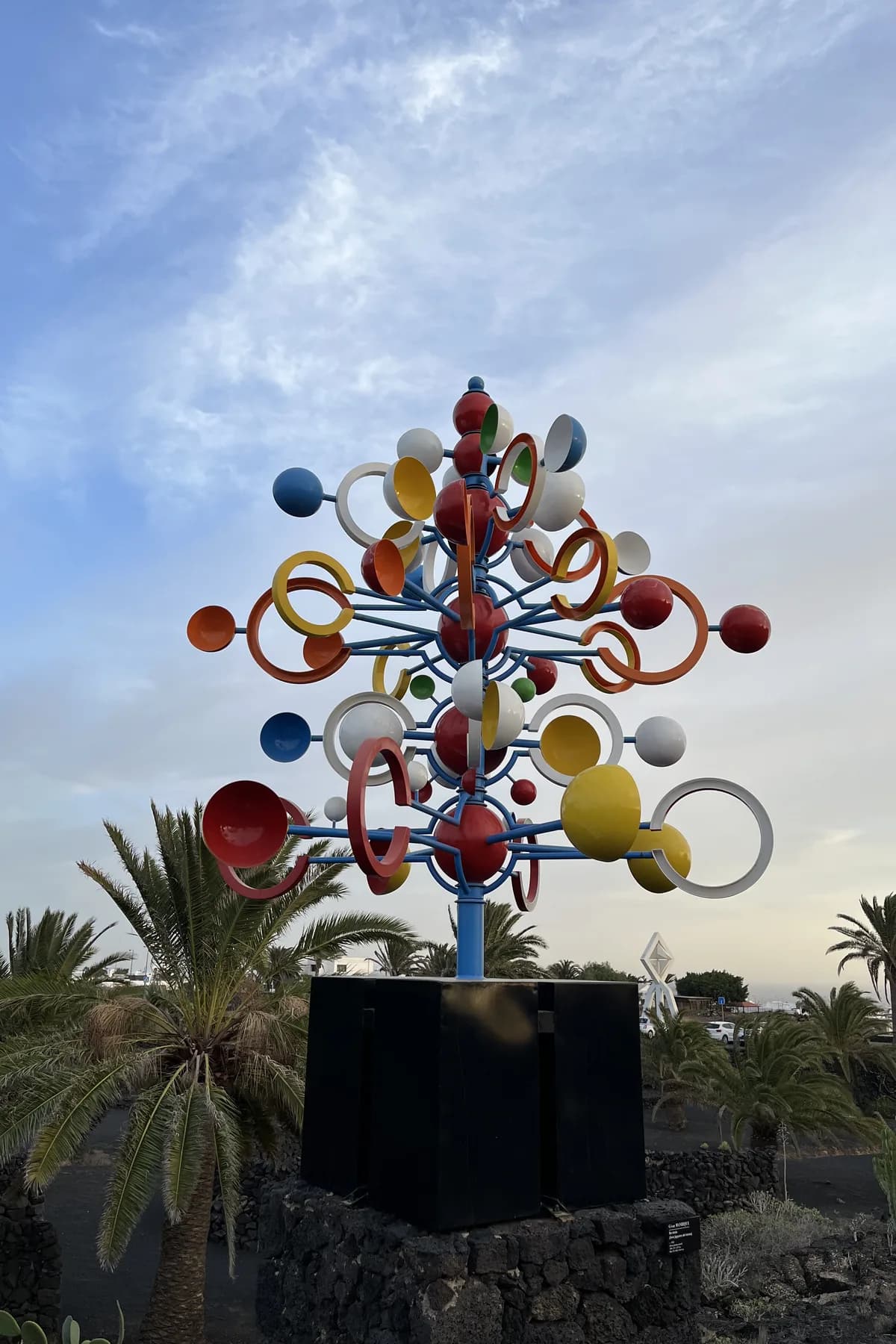
The 21st century has found new uses for it. Wind farms turn the breath into electricity; Famara is a world-class sanctuary of surfing and kitesurfing; and in Costa Teguise, windsurfing enjoys championship conditions for much of the year. Even art signed up: César Manrique's Juguetes del Viento ("Wind Toys") — those white-and-red mobile sculptures on the roundabouts — are exactly what their name says: giant windmills dancing for the alisio, the artist's gift to the island's invisible partner.
And then there is the other wind, the awkward guest. When the flow reverses and comes in from the east or south-east, the calima (Saharan dust haze) arrives: Saharan air laden with suspended dust that yellows the sky, blurs the volcanoes and sends the thermometers jumping. It usually lasts a few days; the locals close their windows, drink water and wait — and the sharp-eyed photographers head out to hunt those golden end-of-the-world lights. Practical tip: if there's a heavy calima, it's the perfect day for museums, wineries and the Cueva de los Verdes.
The island's moral: nobody here talks about the weather just to make conversation. The wind is history, economy, sport and forecast — all in one. Listen to it.