LMA

Teguise beyond the market: six centuries in white and basalt

Lanzarote · 3 min read

Teguise beyond the market: six centuries in white and basalt

On Sundays, Teguise is the island's carnival — the famous market floods the old capital with stalls and coaches. Lovely once. But the connoisseur's Teguise is any other morning, when the crowds are gone and you can hear your steps in Spain's… well, one of Spain's oldest colonial towns: capital of the island for over four centuries, laid out from 1418 around the palace of Princess Teguise's line. Wander the basalt-and-whitewash lanes: the church of Guadalupe on its grand plaza, the Palacio Spínola (now the timple museum, card 70), convents turned art spaces, doorways with five-hundred-year-old coats of arms. Climb to the Castillo de Santa Bárbara on its volcano rim for the piracy museum and the full-island view. Sunday for the buzz, Tuesday for the soul.

Teguise carries its history with the calm of a town that has already survived everything: pirate sackings (the Callejón de la Sangre — Blood Alley — keeps the memory in its name; the pirates card tells the worst of it), the loss of the capital to upstart Arrecife in 1852 (card 72), and finally mass tourism, which it absorbed by the elegant trick of scheduling it — Sundays — and remaining itself the other six days.

The town is one of the oldest European settlements in the Atlantic islands: founded in the early 1400s beside the Guanapay volcano, named for the Majo princess who married into the conquerors' dynasty (the toponymy card savours that story), and for 440 years the seat of the island's power, church and money — all deliberately inland, out of reach of the corsairs' quick raids. That geography preserved it: when the capital moved to the port, Teguise simply stopped in time, and today it is the best-kept historic town in the eastern Canaries — a grid of white façades, dark basalt frames, carved wooden doors and silence.

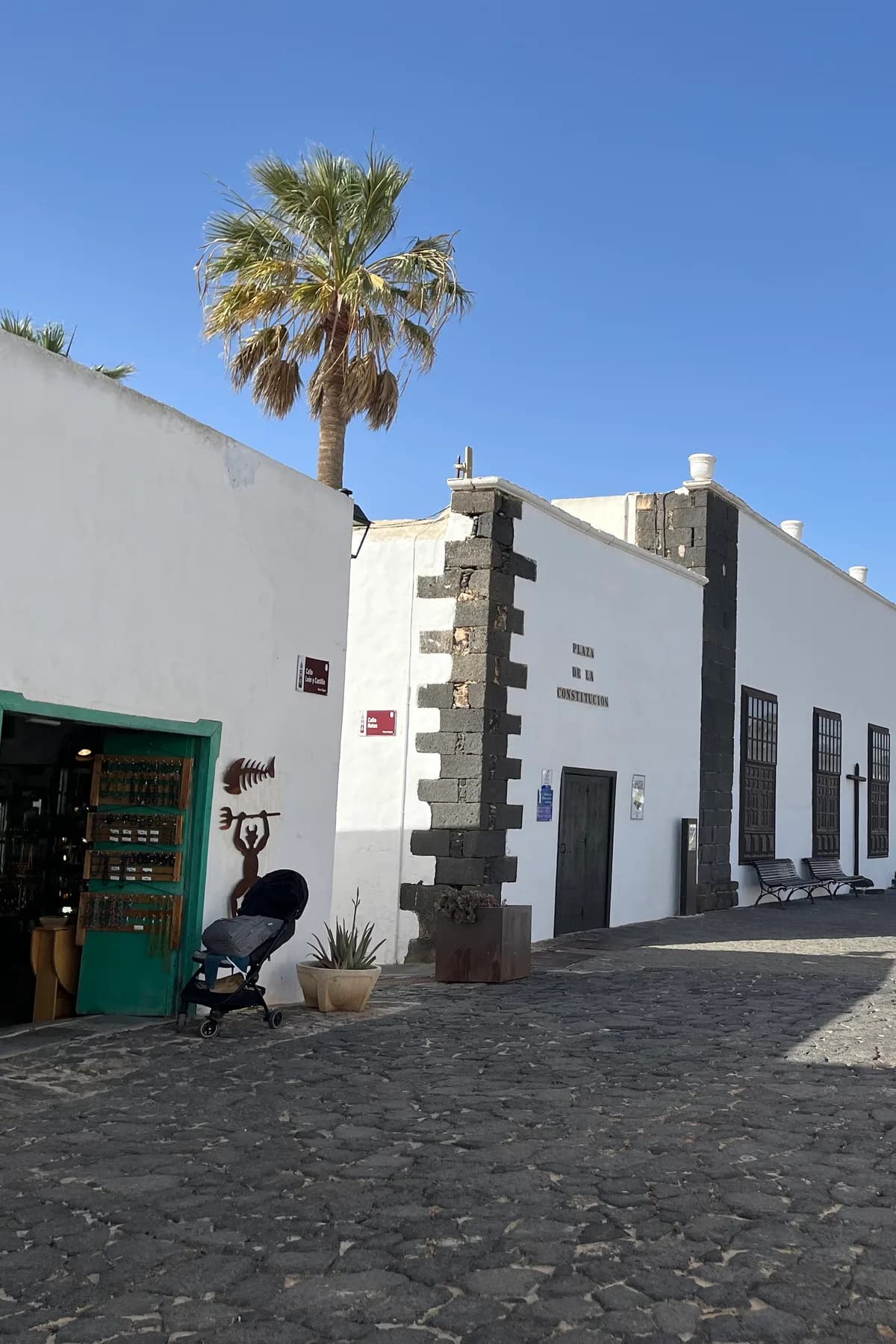
The essentials, unhurried. The Plaza de la Constitución, broad and dignified, with the church of Nuestra Señora de Guadalupe — the island's mother church, rebuilt after every disaster, its tower the town's landmark. Facing it, the Palacio Spínola: an eighteenth-century merchant palace of patios and painted ceilings, now the Casa-Museo del Timple — worth it for the building alone, doubly so for the little instrument's story (card 70). The lanes radiating out hide the rest: the former convents of San Francisco and Santo Domingo (now museum and gallery spaces), the Casa-Museo troves of island furniture, the Callejón de la Sangre behind the church, shops of actual craft between the usual suspects, and courtyard cafés built for second coffees. Everything is walkable in an hour; everything deserves three.

Above town, the exclamation mark: the Castillo de Santa Bárbara, a small stout fortress on the rim of Guanapay volcano, whose watchmen once scanned the sea for sails and lit the warning fires. It now houses the Museo de la Piratería — theatrically fun, genuinely informative — and the 360º view is the island's history lesson in one sweep: Teguise huddled sensibly inland, Arrecife glittering on the coast that was once too dangerous, Timanfaya's fire mountains south, Famara's wall north.

As for the Sunday market: go once, early, for the spectacle — it's the island's biggest social event, and between the sarongs there are real artisans, plus folklore performances by mid-morning. But mark a weekday too. Teguise on a quiet Tuesday, swifts overhead and basalt cool in the shade, is the closest the island comes to time travel — and it costs exactly nothing.

Discover Lanzarote with LMA

More stories

An Island Carved by NatureWhite, Green and Volcanic: The Architecture of LanzaroteCésar Manrique: The Artist Who Shaped an IslandAn Ocean of AdventuresLife Beneath the WavesA Thousand Years of StoriesThe Taste of a VolcanoA Beach for Every MoodWine Grown in AshThe Island That Chose RestraintThe People Who Made This IslandThe Fire MountainsThe island's table: gofio, mojo and the art of honest cookingCycling: the professionals' winter gymLichens and tabaibas: how life comes back after a volcanoThe wind that explains (almost) everythingHalf a volcano, a green lake and a roaring coastlineThe lava tunnel that runs into the seaCreatures from another world beneath your feetSweet endings: quesillo, bienmesabe and the little glass that followsSailing: navigating the sea of the trade windsTales of the Timanfaya devilA river of sand crosses the island (and it doesn't come from the Sahara)600 degrees beneath your shoesMalpaís, lajial, hornitos: learn to read the lavaFarming without rain: the peasant engineering that amazes the worldThe devil of Timanfaya and the Virgin who stopped the lavaThe cochineal: the insect that dyed half of Europe redIllustrious visitors: a palace gifted between kings and the house Omar Sharif lost at cardsTides: the ocean breathes twice a dayThe eternal spring: why it's never cold here — nor too hotBeyond tourism: what the island exportsAloe vera: the island's green pharmacyLa Graciosa: the eighth island, no tarmac and no hurryErmita de las Nieves: the top of the wall (and the island's oldest weather report)Ajaches: the grand old mountains hiding behind PapagayoWhen it rains (yes, it happens): the island's rarest spectacleUnder the darkest sky: stargazing on the volcano islandWine from the ashes: La Geria and the miracle of malvasía volcánicaSpeak like a conejero: little words that open the islandTimple, isas and the Rancho de Teguise: the island's soundtrackWhat the names mean: reading the map's oldest language1852: the year the islands went duty-free (and why your shopping still is)Europe's biggest marine reserve is right next doorCaletón Blanco: white sand on black lava (the north's little Caribbean)Playa del Risco: the beach you have to earn (or the island's best-kept walk)The island's guardians: the projects that look after itReading the ocean: flags, currents and swimming like a localPlan B: the art of the "bad-weather" day (a user's manual)The suitcases to Havana: when conejeros crossed the seaBeyond La Graciosa: Alegranza, Montaña Clara and the wild end of the worldArrecife: the capital that grew out of a puddle (a love letter)The natural pools: Punta Mujeres, Los Charcones and the art of the charcoPapagayo done properly: the golden coves without the golden crowdsThe north loop: palms, cliffs and the island's greenest morningEat where the boats land: a fish-village crawlThe sunset circuit: five ways the island ends a dayThe Stratified City: the labyrinth the wind carved (and nobody visits)Where astronauts learn to walk on other worldsIllustrious islanders: Einstein's physicist, the voice of "El talismán" and the barber of HaríaWhite gold: the salt pans that fed half a fleetThe island the pirates wouldn't leave in peaceWho lives on the island (and who visits it)?The island's calendar: a whole year of fiestas and eventsWhat exactly is the calima?Puerto del Carmen: the little fishing village where it all began (and the parrots' corner)Fifteen million years: the veteran of the archipelagoThe blind crab: white, tiny and found nowhere else on EarthThe hanging garden of FamaraSan Borondón: the island that appears and disappearsSurviving without rain: the tricks of the coastal plantsSurfing: El Quemao, Famara and the wave the champions respect